For years, I've watched the same pattern hold in dozens of companies, long before AI was the conversation.
The hard part isn't picking a platform or running a rollout. It's seeing that your workforce hasn't lost its creativity to have brilliant ideas.
To help you see this, I need to tell you about a customer of Glide’s that embodies this movement. They’re a manufacturer that's been operating for over a century.
Their campus contains two million square feet of manufacturing space. They ship their product by rail, river, and road. It’s the kind of company where when you walk the floor, you can feel the legacy, the history, and the innovation that has happened on it.
However, the systems beyond the product are not innovative.
The culture was handwritten, on-prem, and manual. The IT team was smaller than the HR team and described themselves as firefighters moving from issue to issue.
We were brought in to look at their spending approval process that currently involved putting paper in an envelope and physically mailing it around the country for signatures.
I'm not picking on them. This is most of America. The innovation stops with the core product. Innovative products with antiquated processes.
A gap that nobody quite owns.
Here's where the gap begins to widen.
Requesting anything from IT took forever. Not because IT was bad, but because IT was buried. Every request had to compete with infrastructure work, security patches, compliance projects, and the daily fires. By the time something maybe got built, the person who asked for it wasn't even in the same role anymore.
Read more of my thoughts on LinkedIn
Connect with me hereLearned helplessness in your office
The behavioral pattern behind why your most experienced employees stopped speaking up. And why it isn't a personality problem.
So what does that do to a workforce, year after year?
They stop having ideas.
Not because they aren't creative. Not because they don't care about the business. Because the cost of turning an idea into reality is so high that it isn't worth the emotional investment of even suggesting something. The organization has inadvertently trained its own people to stop improving.
It is the behavioral psychology phenomenon of learned helplessness, on display in a business setting.
"Learned helplessness refers to the problems that arise in the wake of uncontrollability. When experience with uncontrollable events gives rise to the expectation that events in the future will also elude control, disruptions in motivation, emotion, and learning may ensue." — Martin Seligman, Christopher Peterson, and Steven Maier, who first identified the phenomenon in 1967
I've been watching this pattern for years, long before joining Glide. The bottleneck was never ideas. The diagnosis didn't need AI to be true. It just needed time and enough conference rooms to see the same shape repeat.
Data has gravity: A conversation with Glide Co-Founder Mark Probst
Read the interviewBreaking the bottleneck
The mechanism behind why a quiet workforce suddenly comes back to life. And why it has less to do with the people than you'd assume.
Now I want to take you to the moment things changed at this company.
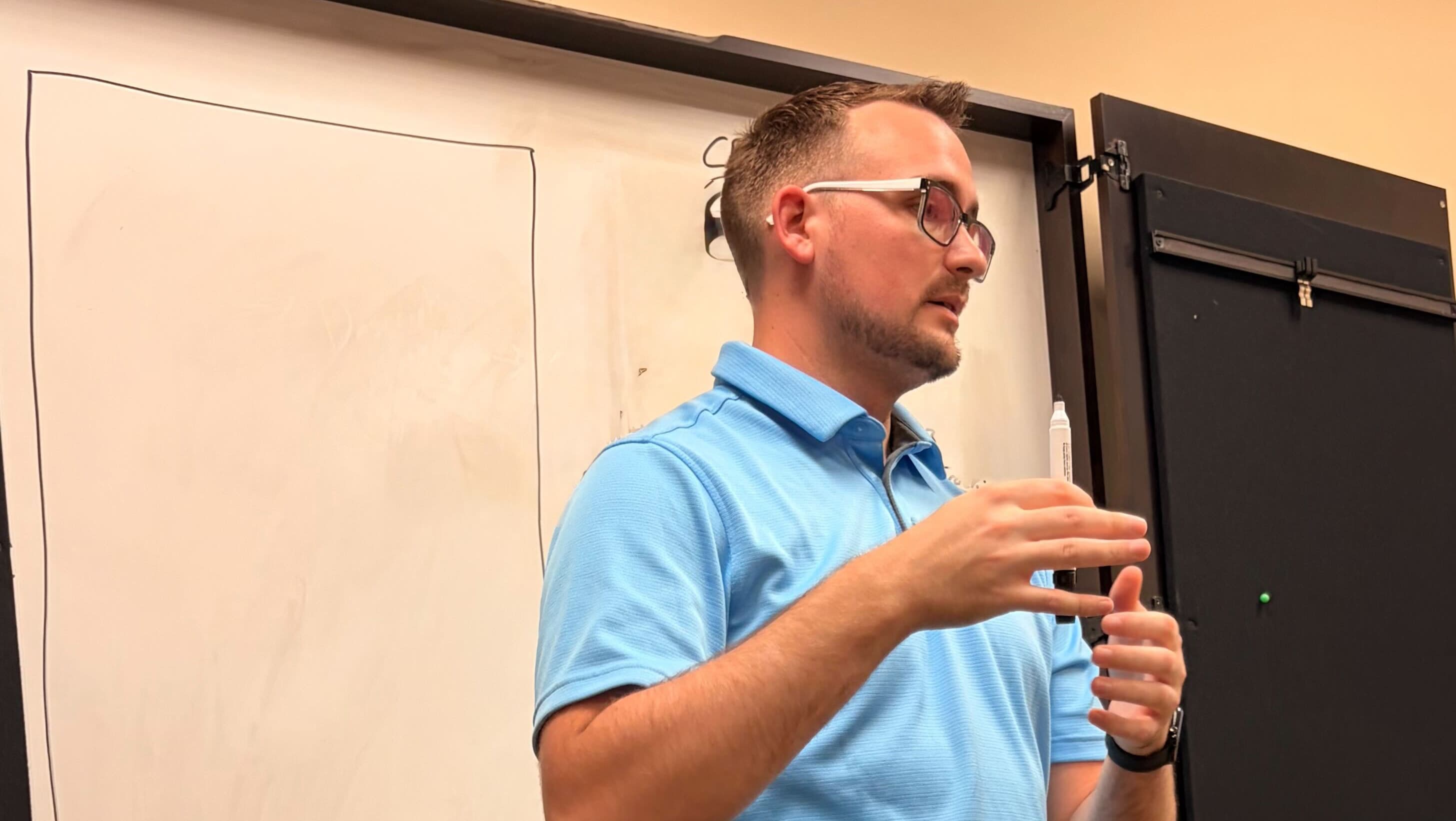
We were sitting around a large conference table with their accounting team, looking at that same spending approval process. The one with the envelope. People were brainstorming what it might look like as a digital workflow. And instead of writing down requirements and scheduling a follow-up, I was making changes live, on the screen, while they talked. I'd publish, and they'd open it on their laptops, right there in the meeting.
This is my favorite part of my job, by the way. Because the reaction is the same everywhere, at every company, and I know exactly when it's coming.
I sit there and I watch the room shift.
People sit up in their seats. The energy changes. Someone makes a suggestion, and instead of writing it on a sticky note for "next quarter," they watch it appear in the app. Someone else says "wait, what if we also..." And we go from zero ideas to ten ideas in the span of twenty minutes.
Because for the first time in a long time, it was worth having the idea.
The bottleneck was never ideas.
It was never motivation.
It was never professional curiosity.
The bottleneck was always the cost of experimenting. When that cost drops to near zero, the ideas come back. All at once. Often from the people you'd assumed had checked out years ago.
This is what I find genuinely exciting about where we are right now. For years, I was the cost reducer. I'd come in, sit at the table, and the cost would drop because I was making the changes live. The catch was that I had to be there. The cost dropped only as far as my calendar allowed. AI changes that math. The unlock isn't dependent on someone like me being in the room anymore. It's available to anyone confident enough or willing to try.
Here's the part I want every operator to internalize. The learned helplessness isn't permanent. It isn't a fundamental flaw in today's workforce. It's something you can lead the way on.
And it doesn't take a six-month rollout or a platform migration to start unlocking this. It takes a few decisions made by leadership about what's allowed, what's encouraged, and what's celebrated.
You can give your team the fun part of their job back. Where they too can help drive the company forward.
The bottleneck was never ideas.