

Glide’s Jack Vaughan has been interviewing members of the team about their areas of expertise and the larger ideas around no-code, AI, and building custom business software. Today, he interviewed Glide Co-Founder and CEO David Siegel on the spreadsheet, and what makes this enduring technology such a compelling beginning for the business apps built on Glide.
Jack:
Glide’s newest campaign is “Start with a Spreadsheet”. Where did that idea come from, and why do you see the spreadsheet as such an important starting point for software?
David:
You could start with a thought experiment: if you wanted to replicate or improve a business process, but could only start with one file, which would it be? Inevitably, it would be the most important spreadsheet from that process.
If you really want to build something truly valuable for a business, asking for a spreadsheet is a thousand times better than asking someone to extemporaneously explain their problem in an AI chat box, for example. The spreadsheet doesn’t just contain the core data; it also includes years of accumulated knowledge and structure about that business and how it operates.
When you start with a spreadsheet in Glide, your app will inherit all that information, and help you create an interface around that process that is safer to collaborate in, easier to use on mobile, and just a more efficient tool overall.
So that's what we're really focused on at Glide right now. How do we solicit those spreadsheet files from the customer so that we can really help them?
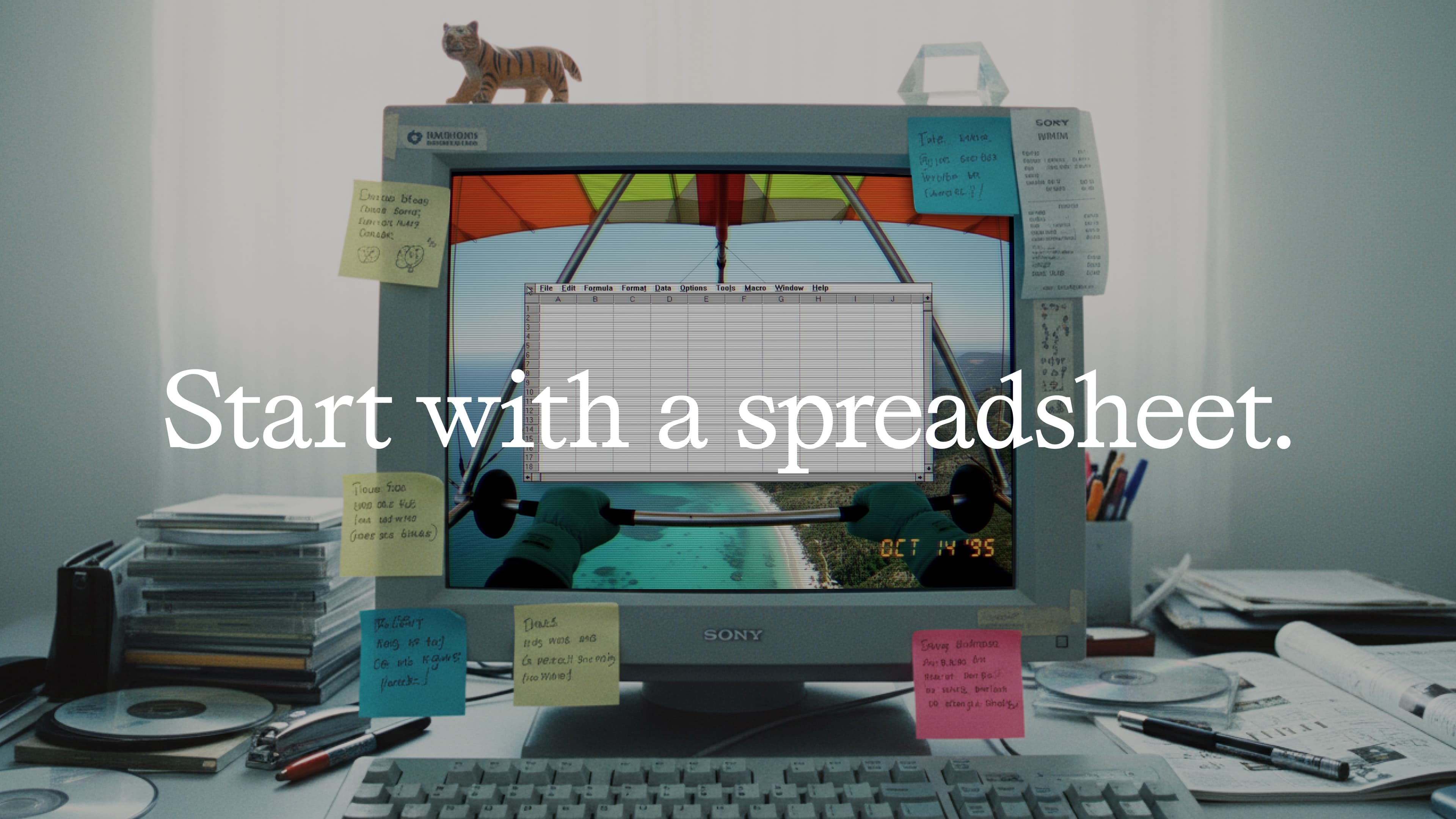
Isn't it time for your spreadsheet to become software?
Watch the videoJack:
Glide began as a spreadsheet tool, right? So this is kind of a return to Glide’s origins in a way.
David:
Yeah, Glide actually originally started as a tool for turning Google Sheets into mobile apps. It’s obviously grown from there, but that fundamental value hasn’t changed. If you have a spreadsheet you need to use as part of a business task, especially if it’s collaborative or needs to be accessible from a phone, building an interface with Glide is the best way to improve that process.
Now, of course, we have a lot more data connections. Most people start from Excel spreadsheets today. We also connect to Airtable and SQL databases, and we have our own native data sources, so you can start from scratch and build everything right within Glide if you want to.
Jack:
You speak with hundreds of customers a year. At one point, you talked about how some of the largest companies in the world are still using spreadsheets for even their most critical tasks. What do you hear these businesses say about their relationships to spreadsheets?
David:
When I talk to customers, what I hear is that spreadsheets are everything. I hear that said so often, “Everything in our business is an Excel Sheet.” They are everywhere. I spend most of my time focusing on the problems of spreadsheets because that's where Glide’s biggest opportunity lies. I get reminded daily how pervasive they are.
Jack:
Spreadsheets have been around for an incredibly long time. Why do you think they've been so enduring as a technology?
David:
I think it’s just that spreadsheets have a very simple design. You can use a spreadsheet with very little experience and get an immediate benefit. They do have complexity, but you have to dig to find it.
“Spreadsheets are simply one of the best classical software designs of all time, if not the best.”
Fundamentally, a spreadsheet is a two-dimensional representation of data in a very accessible interface. I think the easiest thing you could do in a spreadsheet is just make a single-column list: a shopping list, a Christmas list, a to-do list. That's 10% of the app store right there. It's just so simple.
Spreadsheets are physical, too, in two dimensions. You could imagine arranging that list of things on a desk or a scoreboard. That means the spreadsheet can map into our world in a way people are familiar with.
A spreadsheet makes it incredibly easy to design and represent information. There's already so much utility in just that straightforward grid of cells, even before you add formulas or other complex formatting. Honestly, I wouldn't be surprised if 25% of spreadsheets don’t have any formulas at all.
However, once you add the computational aspect, that’s when spreadsheets really become powerful.
Jack:
I've heard you say before that a spreadsheet is both a data model and a user interface. Can you talk about that a little? How do you interpret that idea in the context of Glide, considering it is also a platform that builds interfaces on data?

Data has gravity: A conversation with Glide Co-Founder Mark Probst
Read the interviewDavid:
I think it was Mark Probst, our co-founder at Glide, who first said something like that when we were talking about why spreadsheets have been so successful.
“A spreadsheet is the IDE, the app, and the database at the same time.”
If you're building, for example, a native iPhone app for the App Store, the app and the environment in which you build it are very different. The app is simple. Your users understand how to use it right away. However, the programming environment where you create that app and the languages you use might take you 20 years to learn.
The spreadsheet blurs the lines between those two things. It’s a simple interface that the user can understand right away, but you can also use it in much more complex ways, adding formulas and other features to shape the environment of the spreadsheet right within the spreadsheet itself.
I actually think we’ll see new form factors emerging from AI technology that will behave similarly. Programs that are malleable and act as their own editors. A spreadsheet has always had that quality. It might seem less spectacular because it’s such an austere environment, but I think we’ll soon see the same properties that make spreadsheets so powerful beginning to emerge in high-performance, beautiful, engaging software thanks to AI.
Jack:
Tell me more about the things that spreadsheets weren't necessarily designed to do.
David:
Paper spreadsheets were originally designed as a tool for people, typically bookkeepers, who needed to perform arithmetic on large lists of numbers and cross-reference them. The digital spreadsheet automated all of that. In a spreadsheet, when you change one of the inputs, it just flows through the whole system, no matter how long that chain is, and you see the final number update right away. It's a huge time saver.
At Glide, it's not our opinion that all spreadsheets are better as apps. If you're doing bookkeeping or heavy financial models, a spreadsheet is a really good place to stay. If you’re a solo bookkeeper and no one else ever touches the spreadsheet, don’t change a thing. You don’t risk breaking it by collaborating in it.
But then there are countless spreadsheets out there that have been stretched to do broader business management and operational tasks. These are the areas where spreadsheets start to break down.
Spreadsheets are a poor fit for mobile use. They’re just too vast and detailed to use on a phone. They're also not good for doing collaboration safely. As soon as you share a spreadsheet, it's extremely hard to safeguard any structure you want to preserve.
So, Glide focuses on use cases where processes need to be done on mobile or where many people need to interact with specific data. This is where we really specialize in creating software.
When that software starts from a spreadsheet that has already been shaped to reflect the precise way a specific business moves and operates, it is significantly more powerful. The software simply adapts to their needs right away.