TraceLine QMS
Turn quality issues into verified corrective action
Preview



Overview
The quality team's blind spot
Most manufacturing teams track quality across a tangle of spreadsheets, shared drives, and email threads. Nonconformances get logged but never closed. Supplier responses arrive late — or not at all. Root-cause evidence lives on someone's desktop. Audits arrive and the team spends two nights assembling evidence that should have been a click away. CAPAs stretch past their due dates because nobody can see the full picture in one place.
TraceLine QMS closes the loop. Every defect, corrective action, supplier response, audit finding, and effectiveness check lives in one connected workspace — with real ownership, real due dates, and real visibility from the plant floor to the executive review.
Four connected workspaces
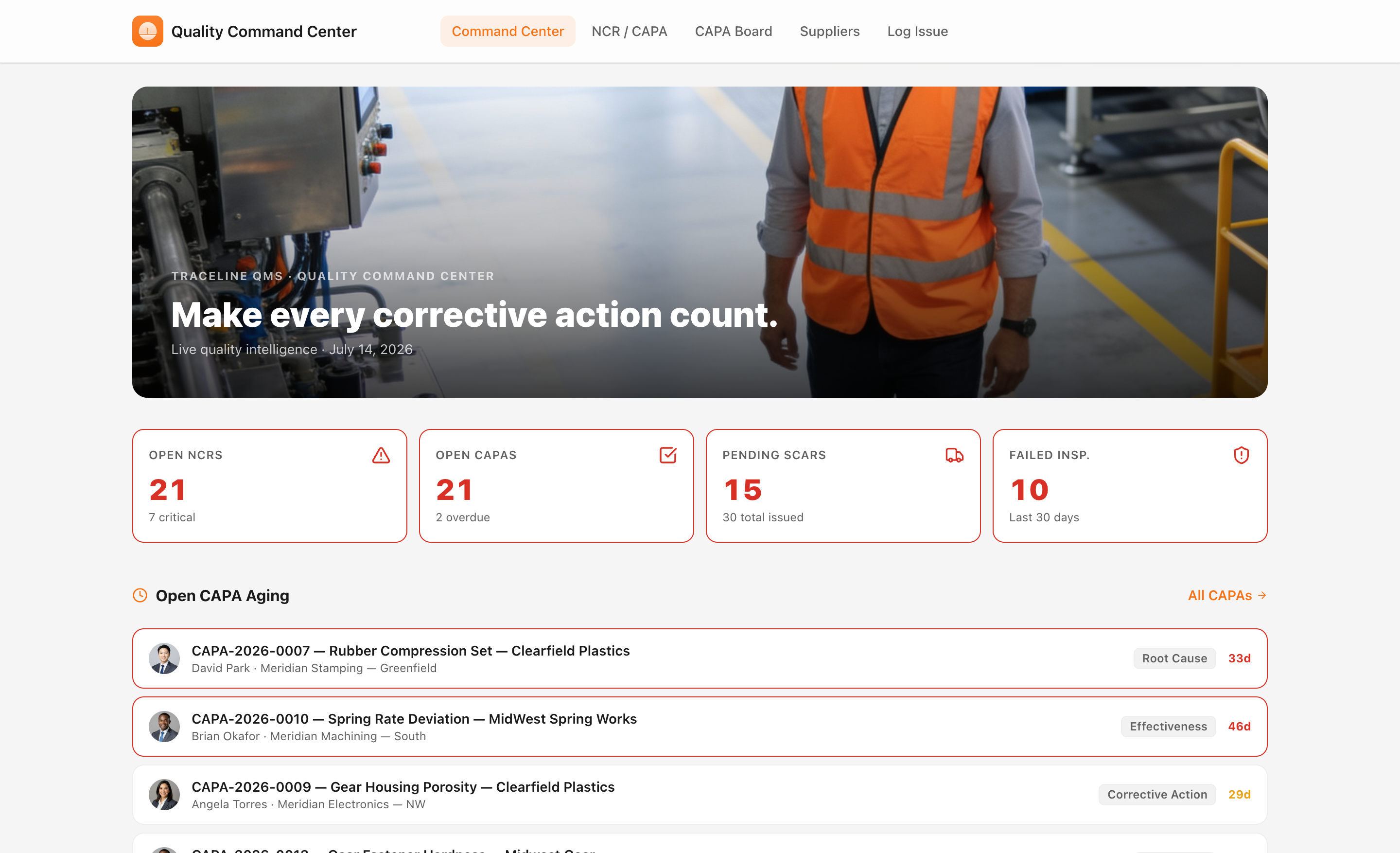
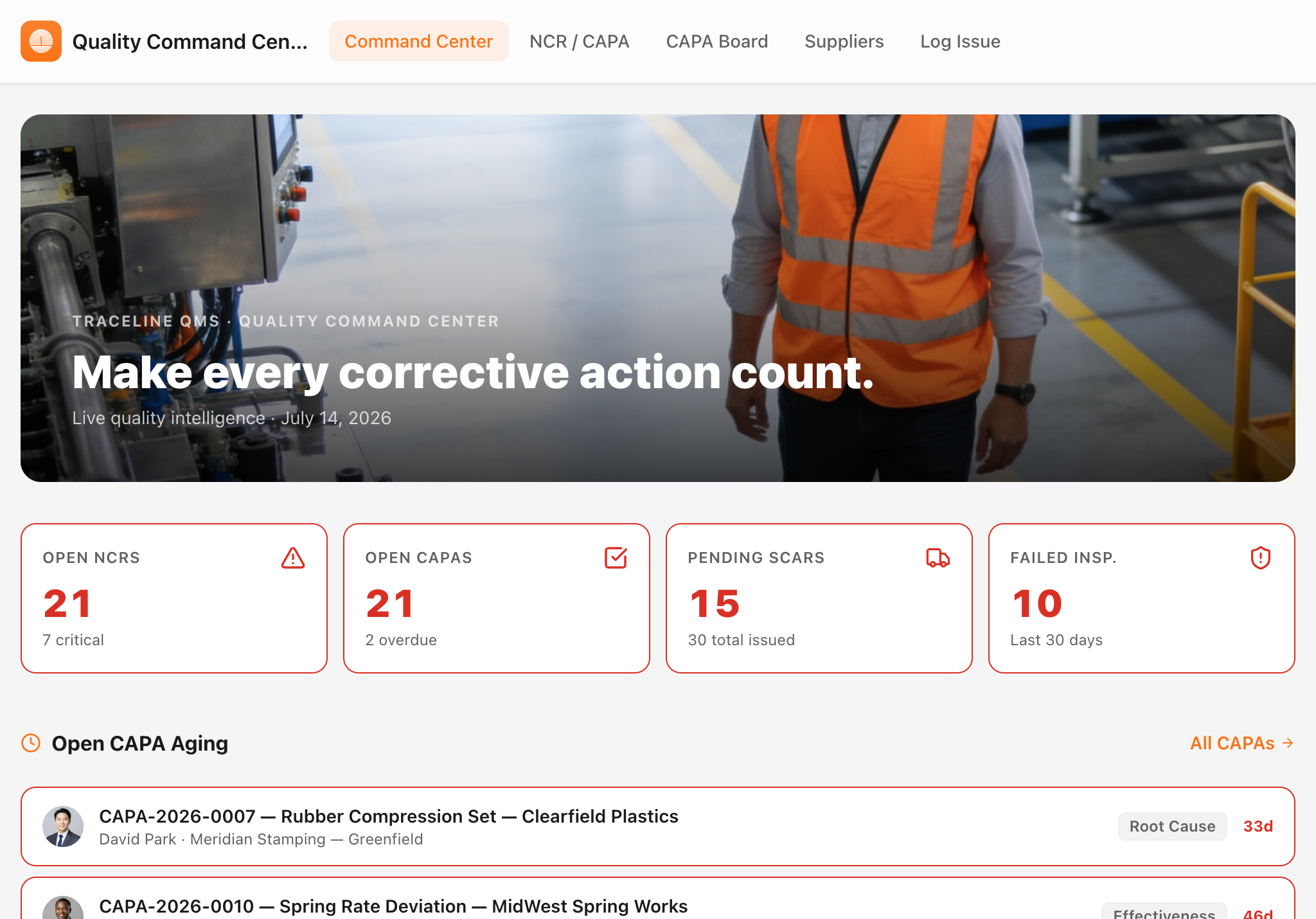
Quality Command Center
The strategic view for quality managers and directors. A live hero dashboard shows open NCR count, CAPA aging, pending supplier corrective actions, and failed inspections — all backed by real data, not manual exports. The CAPA Workflow Board organizes every open corrective action by phase: Containment → Root Cause → Corrective Action → Effectiveness → Closed. Supplier scorecards surface high-risk suppliers before they cause a production disruption. Every NCR links to its CAPA, every CAPA links to its evidence, and nothing falls through the cracks.
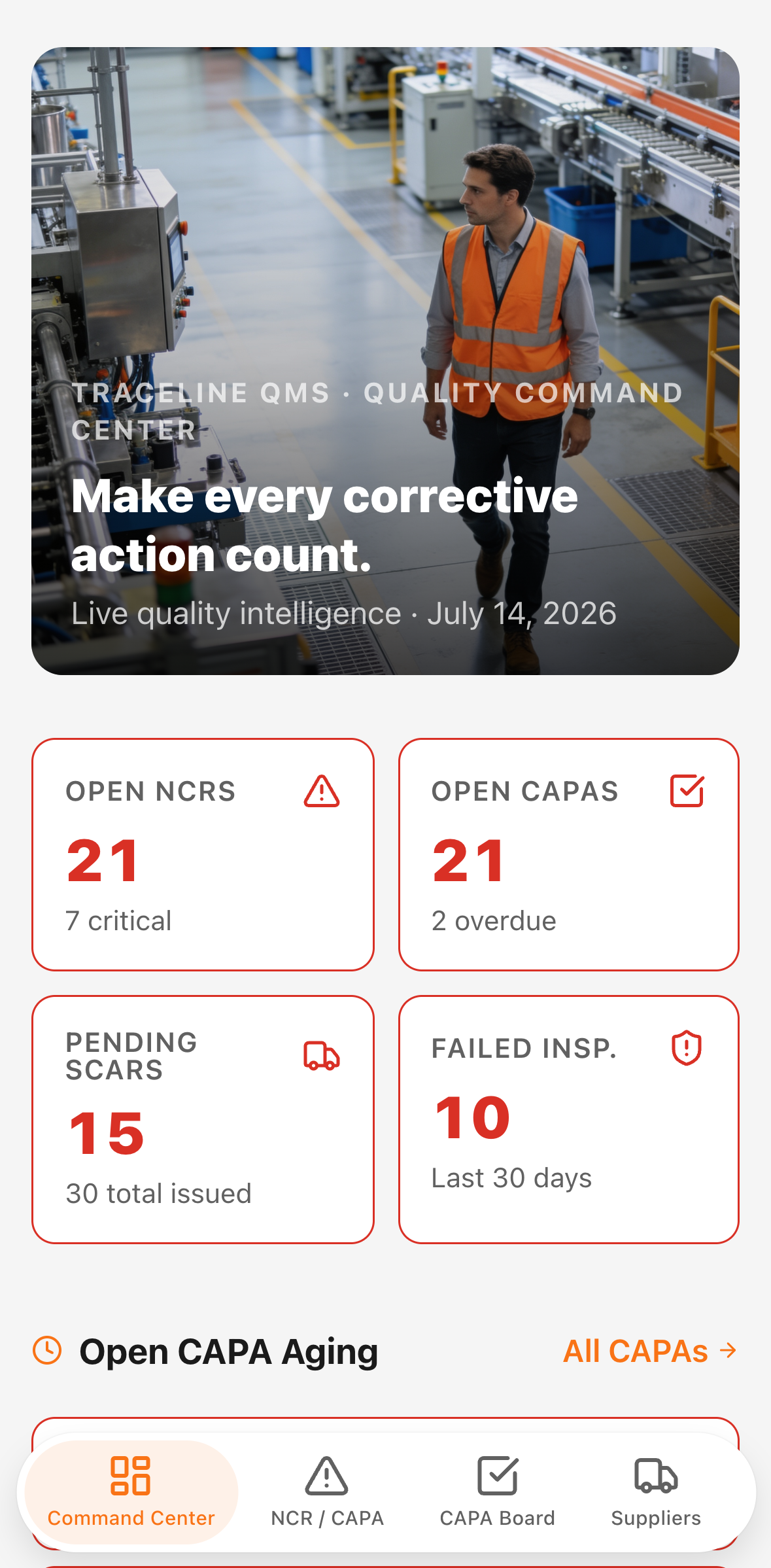
Plant Floor Mobile
Built for operators and quality technicians at 375 px. Large touch targets, card-based layouts, and a shift dashboard that opens on the current plant's open issues and quality holds. Technicians report nonconformances in under a minute — defect type, affected quantity, lot number, immediate containment — and the NCR number is assigned automatically. The quality hold queue shows every held or quarantined lot with a one-tap release action once disposition is complete. Lot and batch lookup connects scan data to inspection records instantly.
Supplier Portal
A focused workspace for supplier quality teams. The SCAR and 8D response queue shows every open corrective action request with its due date and priority. Each SCAR detail page walks suppliers through the eight-discipline response structure: problem statement, containment, root cause, corrective action, preventive action, and effectiveness verification method. Responses flow back to the quality team for review and approval without a single email attachment. Scorecards show quality, delivery, and responsiveness scores alongside compliance document expiry status.
Audit & Compliance
A back-office audit workspace covering ISO 9001, IATF 16949, AS9100, SQF, and internal controls. The audit calendar shows upcoming and completed audits with ratings, finding counts, and lead auditor. Each audit detail includes a finding list, checklist, and a one-click "Convert to CAPA" action that creates a linked corrective action in seconds. The document expiry heatmap flags certificates and SOPs expiring within 60 days — before they lapse unnoticed. The approval queue lets quality managers action pending steps without navigating away from the workspace.
Draft Corrective Action Brief — AI action
The single most time-consuming task in an 8D or CAPA cycle is assembling the written brief that summarizes the problem, evidence, root cause, actions, and verification plan in a form the quality manager can review and release. TraceLine QMS includes a native AI action — Draft Corrective Action Brief — that does this in seconds.
On any NCR or CAPA detail screen, pressing Draft Corrective Action Brief sends the full quality context to the AI: the issue description, defect category, affected quantity, lot and batch identifiers, containment notes, root-cause analysis, supplier response, and actions already recorded. The AI returns a structured 150–220 word draft with eight labeled sections:
- Problem Statement — what failed, where, and how many units are affected
- Evidence Summary — defect photos, measurement data, and lot traceability
- Likely Root Cause — the systemic cause identified or under investigation
- Containment Actions — what was done immediately to prevent spread
- Corrective Action — the process change or supplier action being implemented
- Prevention — how recurrence is being blocked across similar processes
- Owner and Due Date — named accountable person and target closure date
- Effectiveness Verification Question — a concrete, measurable test to confirm the fix worked
The draft is clearly marked for quality-manager review before release — it accelerates assembly of 8D and CAPA briefs while keeping approval authority with the quality team. Teams that previously spent an hour per CAPA on brief writing can redirect that time to investigation and verification.
Closed-loop quality workflow
Every quality event in TraceLine follows the same verified lifecycle:
Defect detected → Containment → Root cause analysis → Corrective action → Evidence collection → Effectiveness check → Approval → Closed
Statuses, phases, and due dates are visible at every step. Overdue CAPAs surface in red on the command center. Supplier responses past their due date are flagged automatically. Nothing closes without a verified effectiveness check.
Built for serious manufacturers
TraceLine QMS uses manufacturing vocabulary throughout — NCR, CAPA, SCAR, 8D, containment, disposition, quality hold, approved supplier, audit finding, MPI, CMM, AQL, PPAP — because quality teams should not have to translate between their work and their tools. Multi-site architecture supports plants across locations with per-plant inspection records, lot traceability, and audit scope. Supplier tiers, risk ratings, and scorecard metrics give procurement and quality a shared view of supply chain health.